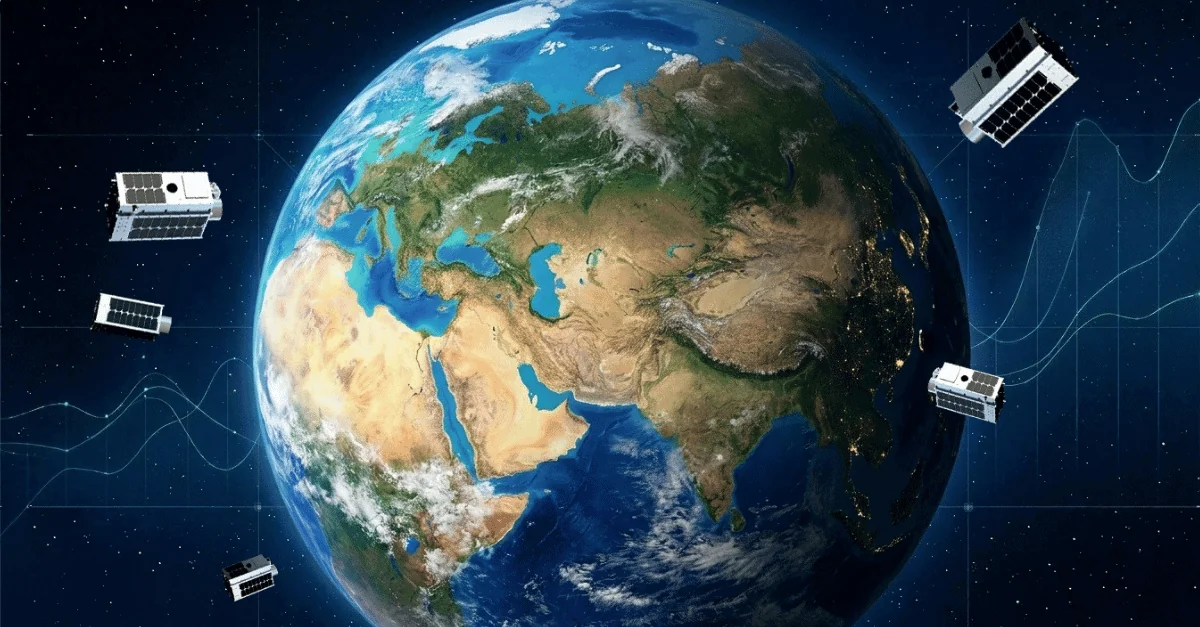


Twice the sensitivity, twice the coverage — Gen2 reaches orbit in early 2028.
GHGSat Unveils Plans for Second-Generation Satellite, Setting a New Standard for Methane Detection from Space
Montreal, Sept 21, 2026 – Ten years ago, GHGSat launched the world’s first high-resolution methane-detecting satellite, and in doing so, fundamentally changed what was possible for emissions monitoring from space. Today, after a decade of relentless innovation, GHGSat unveils its next leap forward: a second-generation satellite, with a detection threshold of 50 kg/hr.
Building on the proven heritage of the world’s largest constellation of methane-detecting satellites, the second generation will deliver a twofold improvement in detection sensitivity and daily coverage per satellite. Once operational, the new-generation satellites will detect onshore methane emissions at a 50 kg/h threshold, compared to 100 kg/hr in GHGSat’s original satellites. Daily coverage per satellite will double from 10,000 km² to 20,000 km², while data delivery will remain at the industry’s highest speed: within 24 hours. The satellite is scheduled to reach orbit in early 2028.
“Our second-generation satellite is the next step in a decade of delivery: the next evolution of the only commercially operating, independently validated methane monitoring constellation in the world.” said Stephane Germain, Chief Executive Officer of GHGSat. “The satellite builds on the same peer-reviewed, independently validated science that has made GHGSat the partner of choice for the world’s largest industrial operators. As demand for credible and precise emissions data grows, we are ready to meet it, backed by a proven track record of results.”
Gen2 will also benefit from integration with GHGSat’s DATA.AIR aircraft sensor, which reaches detection thresholds approaching 3.5 kg/h at 90% probability of detection according to METEC-validated testing—a sensitivity that enables operators to meet OGMP 2.0 reporting requirements. The combination of satellite and aircraft technology creates a fully integrated, multi-tier tip-and-cue system combining Sentinel-5P, GHGSat satellite data, and airborne assets.
The Foundation: A Decade of Industry-Leading Innovation
GHGSat’s Gen1 constellation already delivers capabilities no other satellite system can match:
- Daily revisit frequency: The Gen1 constellation monitors millions of industrial facilities annually, with the unparalleled ability to revisit any site daily. In 2025 alone, GHGSat satellites observed more than 4 million facilities, detecting more than 20,000 emissions events. No government or commercial satellite system matches this pace.
- Highest level of validation: GHGSat’s Gen1 satellite constellation is the only system in the sector to achieve independent validation from institutions including Stanford, ESA, METEC, and NASA. GHGSat is also the only operator with a proven commercial data model, and the only provider named as a trusted partner with a MiQ-compatible methodology—critical credentials for operators navigating increasingly stringent emissions reporting requirements.
- Redundancy and reliability: With GHGSat’s Gen1 constellation, there is no single point of failure. This operational resilience means that operators and regulators can count on consistent, high-frequency data regardless of individual satellite availability.
These advantages are the result of ten years of sustained engineering rigor and lessons learned from working as a trusted partner with carbon-intensive industries. With the announcement of Gen2, GHGSat continues to invest in its founding mission: providing precise, validated, and actionable greenhouse gas monitoring data from space, at the scale and reliability that industrial operators and government agencies demand.
About GHGSat
GHGSat is a global technology leader with pioneering emissions-monitoring capabilities that drive industrial efficiency with positive impact. Harnessing the power of satellites and aircraft, GHGSat traces emissions directly to their source at an unmatched speed, delivering the data and insights required to take action. A trusted partner for organizations around the world, GHGSat empowers decision-makers to tackle emissions, accelerating progress towards a resilient energy future.
For media inquiries:
Alison Boyer
Director, PR & Communications