GHGSat, the global leader in emissions-monitoring technology, today announced the successful launch and deployment of its two newest satellites, Eleanor (C-18) and Aidan (C-19), continuing the company’s steady expansion of the largest constellation of satellites dedicated to methane detection in the world.
As industries and governments around the world work together to tackle methane—one of the fastest and most cost-effective levers for near-term climate action—GHGSat is committed to expanding the scope of data available to support that effort.
“Methane might be invisible to the naked eye, but its reduction has tangible impacts for the planet,” said Stephane Germain, GHGSat CEO. “I’m proud of how far our constellation has grown since our first launch. That growth translates directly into better data and better outcomes.”
Each new satellite adds fresh capacity and coverage for customers, and boosts service capabilities in the asset-dense regions where demand is highest. The added scale means more emissions events detected, and faster alerts delivered to the operators and regulators who rely on the data to act.
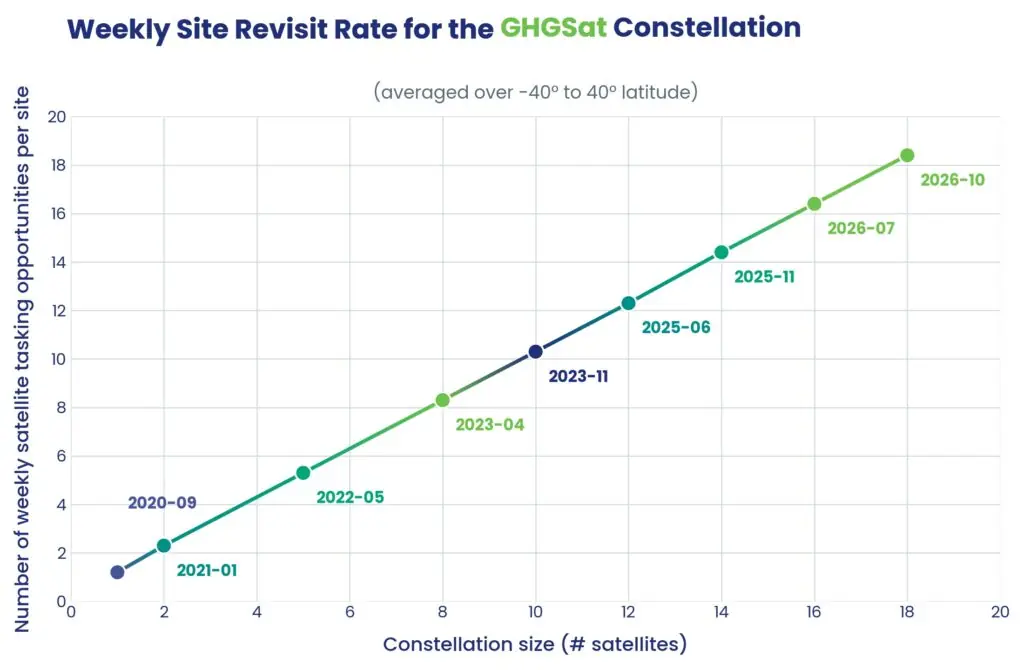
As the fleet has rapidly grown, so has its revisit capabilities. In 2023, with more satellites in orbit, GHGSat’s constellation could revisit a given site on a near-daily cadence. Today, near the end of 2026, GHGSat’s expanded constellation is capable of providing multiple passes daily, which increases the opportunity for data collection in the targeted areas. This provides more flexibility for customers as they design their monitoring programs, while accounting for challenges such as weather conditions that impact the ability to revisit sites of interest.
Both satellites also carry something more personal: a meaningful name. In keeping with GHGSat’s tradition of naming its satellites after the children of its employees, the newest additions to the fleet are known as Eleanor and Aidan.
C-18, Eleanor, is named in honor of the 11-year-old daughter of Andrew Gagnon, GHGSat’s Director of Software. For Andrew, the tradition of recognizing employee children is a reminder of the responsibility that comes with GHGSat’s mission of emissions reduction. “This planet will be here long after I’m gone, and it’ll be our children who inherit the environment in which they’ll grow up,” he said, noting that his family lives by the Scout motto of “leave no trace”—an ethos he sees carried through in his work at GHGSat. Both Eleanor and her community of friends and teachers are excited to see her namesake launch into orbit: she’s given the whole experience so far “an awesome two thumbs up.”
Named after the two-year-old son of Laura Bradbury, GHGSat’s Space Systems Operations Manager, C-19 is known as Aidan. Laura hopes the name will help spark a sense of wonder in Aidan as he grows. “We wanted to encourage Aidan’s curiosity in science and engineering, to keep asking questions and exploring how things work,” she said. While Aidan is still a little young to grasp exactly what’s happening, he’s fascinated by rockets and space launches. As Laura put it, “he thinks it’s pretty cool there will be a satellite in space with his name on it.”
Since 2016, GHGSat has pioneered the detection and measurement of facility-level methane emissions from space, working closely with governments and industry to turn satellite data into action. Among its longest-standing partnerships are those with Chevron, ExxonMobil, and Saudi Aramco, three of the world’s largest energy producers, as well as the UK Space Agency, all of whom rely on GHGSat’s data to inform their emissions-reduction strategies. To date, GHGSat has supported the mitigation of more than 21 million tonnes of CO2-equivalent methane emissions, equivalent to taking roughly 4.9 million cars off the road for a year.
With Eleanor and Aidan now in orbit, GHGSat’s constellation, and the community of partners it supports, continues to grow.